Reputation Management for SaaS: What Each Layer Costs and What It Fixes
Search "reputation management" and most of the first page is agencies selling monitoring dashboards and content suppression. That market was built for restaurants, hotels, and executives with a bad news cycle. A software product has a narrower problem: five or six findable artifacts decide what a buyer thinks of you before they ever open your pricing page, and each one has its own price to fix.
This post prices the work layer by layer, using figures we re-verified on competitor pricing pages in July 2026 and data from our own crawl of SaaS homepages. The broader system for building and defending a profile lives in our pillar on managing your reputation. Here the question is narrower: where does the money go, and what does each layer actually repair.
The four surfaces that hold a software reputation
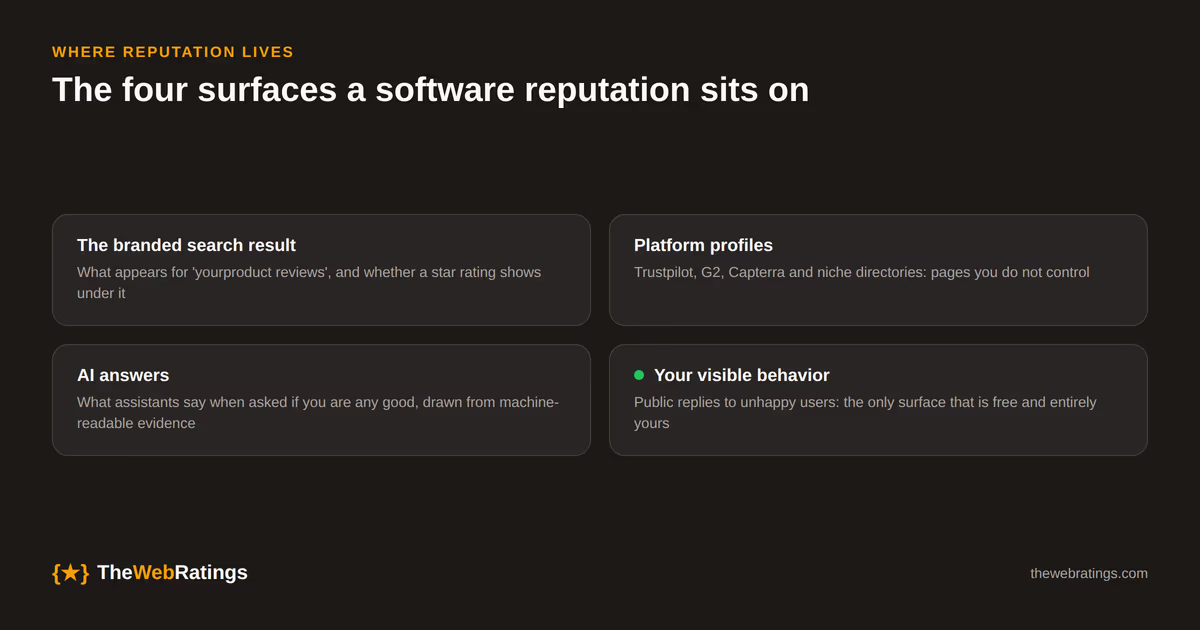
Before pricing anything, be precise about what you are buying. For a SaaS product, reputation is concentrated in four places.
The branded search result. What a buyer sees when they search "yourproduct reviews": your own pages, review platform profiles, a Reddit thread, and whether a star rating appears under any of them.
Platform profiles. Trustpilot, G2, Capterra, and the niche directories in your category. You do not control these pages, and on some of them competitors can advertise against you.
AI answers. What ChatGPT, Perplexity, or an AI Overview says when asked whether your product is any good. These systems lean on structured, machine-readable evidence, which is why markup that nobody reads directly has started to matter.
Your visible behavior. How you reply to a one-star review, in public, with your name on it. This is the only surface that is free and entirely yours.
Every commercial "reputation management" product touches one of those four. Very few touch more than two, which is why buying one tool and expecting the problem to close usually disappoints.
What each layer costs
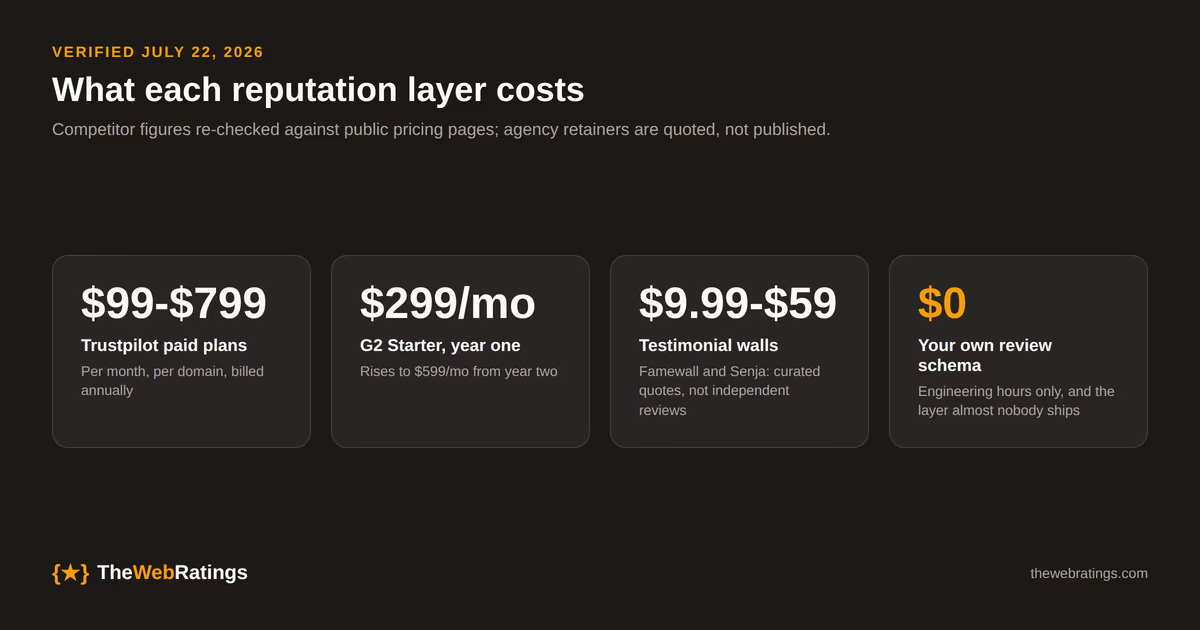
The table below groups the market by layer rather than by vendor. Every competitor figure was re-verified against the vendor's public pricing page on July 22, 2026; agency retainers are quoted rather than published, so we have not invented a number for them.
| Layer | What it costs | What it fixes | What it does not fix |
|---|---|---|---|
| Monitoring and alerting | $0 with Google Alerts and Search Console; paid social listening tools on top | Knowing when something is said | Nothing about what is said |
| Review platform profile | Trustpilot free tier, then $99/mo (Starter, annual) to $799/mo per domain; G2 $299/mo in year one, rising to $599/mo from year two | Presence and volume on a high-authority profile | Control of the page, or who advertises on it |
| Directory placement | Capterra listing is free; visibility is sold through PPC bidding with unpublished click prices | Category-page traffic while you pay | Anything the moment you stop bidding |
| Testimonial walls | Famewall $9.99 to $79.99/mo; Senja $29 to $59/mo | Curated quotes on your own site | Independent, verifiable proof |
| Your own structured data | $0 plus a few engineering hours | Star eligibility in search, machine-readable evidence | Nothing, if the reviews behind it are thin |
| Agency retainer | Quoted, not published | Media handling, legal escalation, non-software surfaces | The evidence base, which is still yours to build |
Two rows deserve comment. The platform row is the one most teams reach for first and the one with the widest range: Trustpilot's paid tiers are annual contracts, and the $99/mo Starter caps invitations at 100 a month, so the tier most growing teams land on is meaningfully higher. The testimonial row is cheap because it is a different product. Famewall and Senja build attractive walls of quotes you selected, which persuades on a landing page and does nothing for a buyer who is specifically looking for reviews you did not choose.
The free layer almost nobody uses
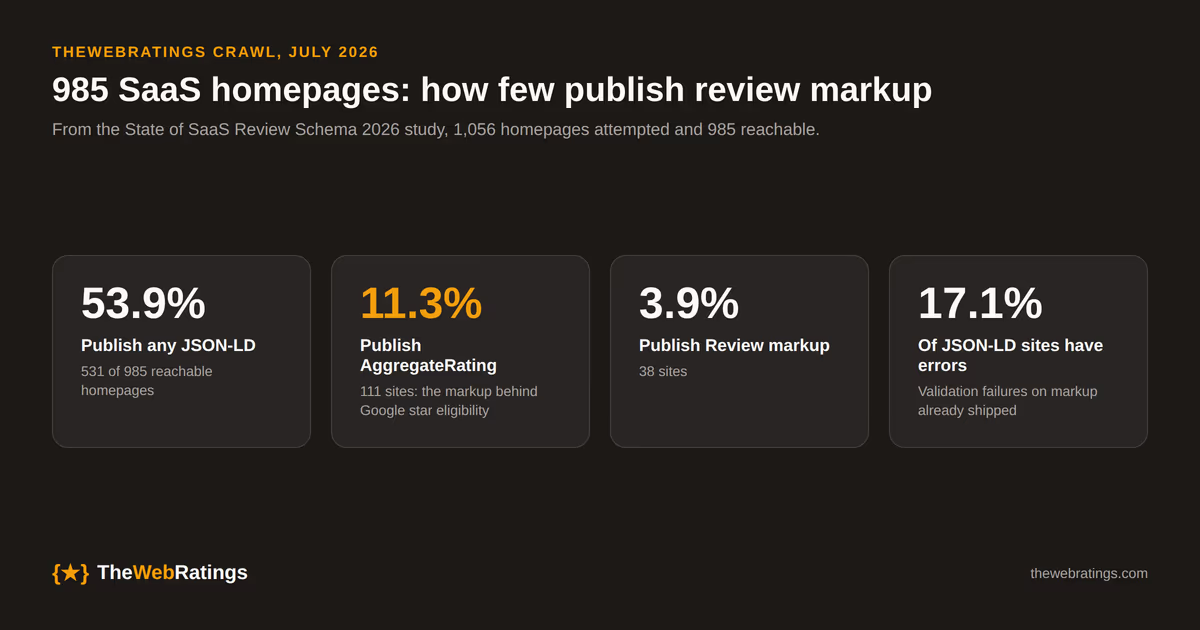
We crawled 1,056 SaaS and web-app homepages in July 2026; 985 responded. Of those, 531 (53.9%) published any JSON-LD at all, 111 (11.3%) published AggregateRating, and 38 (3.9%) published Review markup. Among the sites that did ship JSON-LD, 17.1% had at least one validation error. Put in one sentence for anyone quoting it: in TheWebRatings' July 2026 crawl of 985 reachable SaaS homepages, only 11.3% published the AggregateRating markup that makes a star rating eligible to appear in Google results.
The full method and per-type breakdown are in the State of SaaS Review Schema 2026 study. The practical read is that the cheapest reputation layer is also the emptiest one. Star ratings under a search result are the single most visible trust signal a buyer sees, they cost nothing but the markup, and nine out of ten of your competitors have not shipped it.
Two cautions, because Google enforces this narrowly. Self-serving AggregateRating on a page about your own product is against Google's structured data guidelines, so the markup has to sit on a page that hosts genuine, visible reviews. And the reviews behind it need to be real: markup on top of six curated quotes is a validation pass and a credibility failure.
Negatives are a response problem before they are a removal problem
The instinct when a bad review lands is to get it taken down. On most platforms that path is narrow, slow, and only open when the review breaks a specific rule. The path that is always open is replying well, in public, quickly. A calm reply that names the specific problem and says what changed reads to the next buyer as evidence that you handle things, and it is the cheapest reputation asset available.
Our templates for that are in how to respond to negative reviews. Where a review is fabricated rather than merely harsh, the mechanics are different, and platform-level verification is the part that decides whether a dispute goes anywhere: why fake reviews are killing review platforms covers what verification actually rules out.
Volume matters more than any single reply. A profile with nine reviews is hostage to the next unhappy user, because one one-star review moves the average by half a star. A profile with two hundred absorbs it. Most reputation emergencies are collection failures that arrived late.
A 30-day version that costs almost nothing
If you are starting from a blank profile and a small budget, the order below gets the most durable pieces in place first. It is deliberately unglamorous.
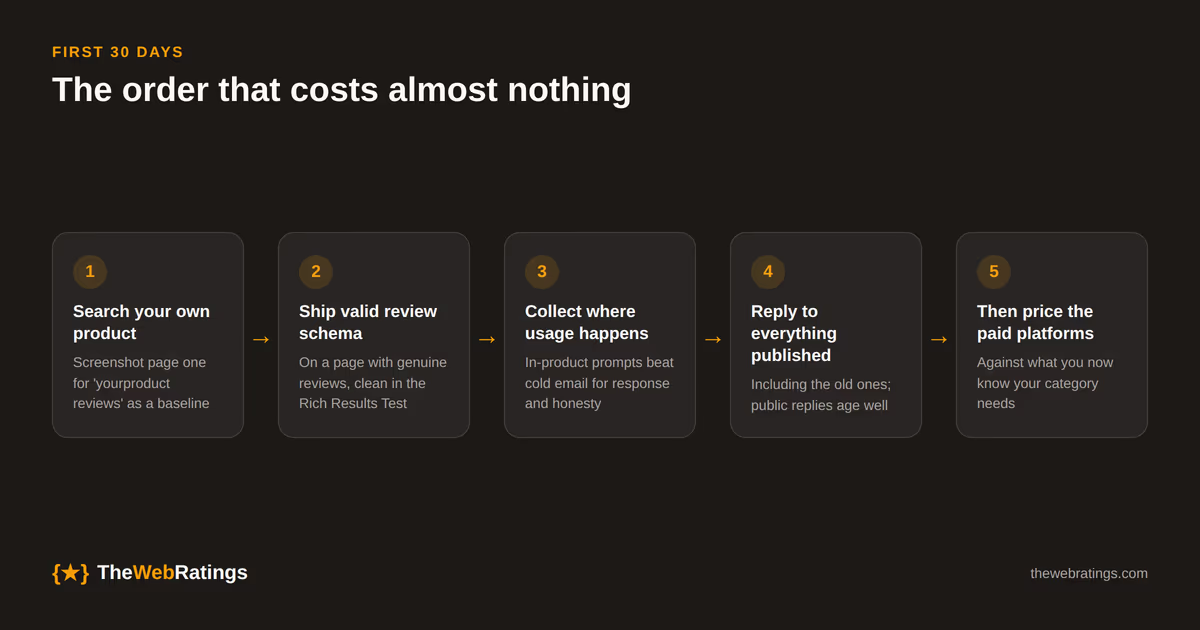
- Search your own product the way a buyer would. "Yourproduct reviews", "yourproduct vs competitor", "is yourproduct legit". Screenshot the first page. That is your baseline, and it is usually more informative than any monitoring subscription.
- Ship valid review schema on a page with real reviews. Run it through Google's Rich Results Test until it is clean. This is the free layer from the section above.
- Turn on collection where usage happens. In-product prompts at a moment of success outperform cold email, and they produce reviews from people who actually used the thing.
- Reply to everything already published, including the old ones. Public replies age well and cost nothing.
- Only then price the paid platforms, against what you now know your category needs. A $299/mo G2 profile is a reasonable buy for an enterprise sales motion and a poor one for a small indie tool.
We build a review platform, so weigh this next part accordingly. TheWebRatings exists for steps 2 and 3: verified in-app collection, a public trust page carrying AggregateRating and Review schema, on a free tier with Pro at $19/mo. If you are comparing that against the incumbent, our Trustpilot alternatives page lays the two out side by side, including where Trustpilot's consumer reach genuinely wins.
When an agency is the right call
Retainer agencies earn their fee on problems that are not about reviews. A defamation claim, a news story with legs, an executive's personal search results, a multi-location business with Google Business Profiles to manage: those are real specialisms and they are not what a review tool does. If your problem is that buyers cannot find evidence you are good, an agency will mostly rebuild the evidence base you could have built yourself, at a markup.
The dividing line is whether the harmful thing is true. Fixing a reputation you have earned is a product problem wearing a marketing costume, and no retainer solves it. Fixing a reputation that is simply invisible is an evidence problem, and evidence is cheap.
Frequently asked questions
It depends entirely on which layer you buy. Monitoring can be free with Google Alerts and Search Console, structured data costs only engineering time, and public replies cost nothing. Paid review platforms are where the real money sits: Trustpilot's paid plans ran from $99/mo to $799/mo per domain on annual contracts when we checked in July 2026, and G2's Starter plan was $299/mo in year one rising to $599/mo from year two. Agency retainers are quoted individually and are rarely worth it for a software product whose main gap is review volume.
For most small teams, no, at least not first. The two highest-return actions are free or close to it: publish valid review schema on a page with genuine reviews, and collect reviews systematically from inside your product. Software that alerts you to mentions is useful once you have enough mentions to miss some, which is a later-stage problem than most vendors imply.
Rarely, and only when it violates a specific platform rule such as being fabricated, containing personal information, or coming from someone with an obvious conflict of interest. Every major platform has a flagging process, but the outcome is slow and uncertain. Assume the review stays, reply to it well in public, and put your effort into having enough genuine reviews that one negative does not define the average.
It affects what a buyer sees before they click, which is most of the battle. AggregateRating and Review markup on a page with real reviews makes your result eligible for a star rating in Google, and gives AI assistants machine-readable evidence to quote when someone asks about your product. In our July 2026 crawl of 985 SaaS homepages, only 11.3% had that markup, so it remains one of the few genuinely underused levers.
Enough that a single one-star review cannot move the average noticeably, which for most products means the low hundreds rather than a dozen. Recency matters as much as count, because a buyer reads a profile whose newest review is eighteen months old as abandoned. Steady collection beats a one-time push every time.