Public Replies vs Private Support: Where to Resolve Customer Complaints
When a customer complains in a public review, most founders treat it as a choice between answering in public and moving the conversation to support. In practice almost every public complaint needs both, in a fixed order: a short public reply written for the people who will read the exchange later, then a private thread where the actual fixing happens. The useful question is which details go where, and that is what this post covers.
The two channels have different audiences. The private thread is for one person with one problem. The public reply is for every prospect who opens your review profile over the next few years, and the reviewer is a minor part of that audience. Mixing them up is how companies end up debugging a CSV export in a Trustpilot reply, or answering a public one-star review with a support ticket number and nothing else. For the wider reputation playbook, start with the pillar guide on managing your reputation.
What each channel can and cannot do
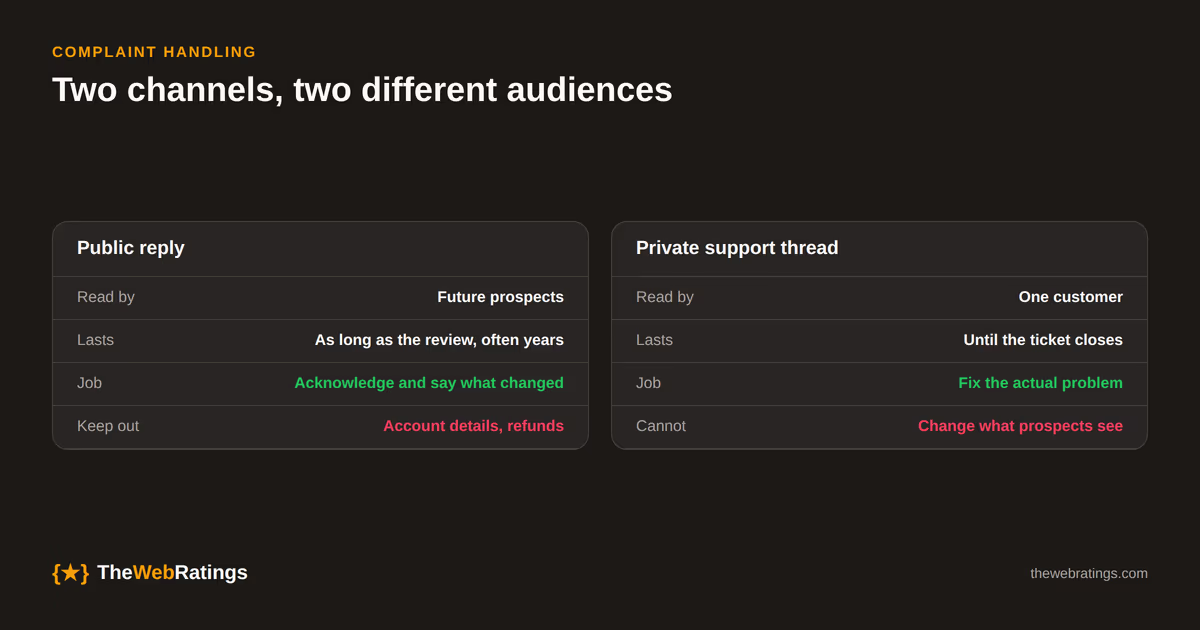
The table below is the comparison we use when deciding where a piece of a complaint should live.
| Public reply | Private support thread | |
|---|---|---|
| Who reads it | Future prospects, the reviewer, sometimes competitors | The customer and your team |
| How long it lasts | As long as the review stays up, often years | Until the ticket closes |
| What it can fix | Trust in how you handle problems | The customer's actual problem |
| What it cannot do | Debug, refund, or share account details | Change what prospects see on the profile |
| Main risk | Arguing, oversharing, or sounding scripted | Looking like you hid the complaint |
The last row is the one people underweight. A complaint that gets resolved privately with no public trace still reads, to the next prospect, as an unanswered one-star review. And a complaint argued out in public reads as a company that fights its customers, even when the company is right on the facts.
What belongs in the public reply
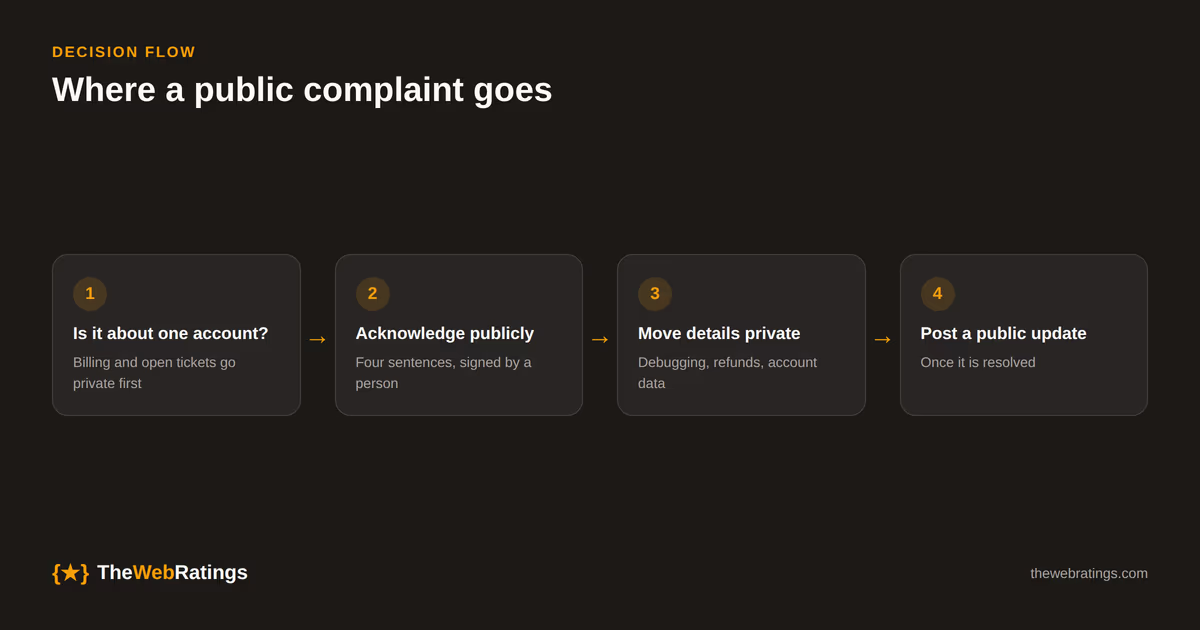
A public reply should give a prospect four things and stop: proof you read the review, ownership of your part, what changed or will change, and where the conversation continues. Four sentences is usually enough. Our response framework and five templates for common cases are in how to respond to negative reviews; the short version is that the reply should still make sense to someone who never sees the private follow-up.
Things that work well in public:
- The incident, named plainly. "The export failure on the 14th" tells prospects you know your own system. "We're sorry for any inconvenience" tells them nothing.
- The fix, if one shipped. A reply that says "fixed in the 3.2 release" turns an old complaint into evidence that feedback works.
- One correction of a factual error, stated once and neutrally. If the review says you charge for exports and you do not, say so in one sentence without commentary.
- A human name. A reply signed by a person reads differently from one signed by a brand account.
What belongs in private
Anything that is about this specific customer's account belongs in the private thread. That covers more than people expect.
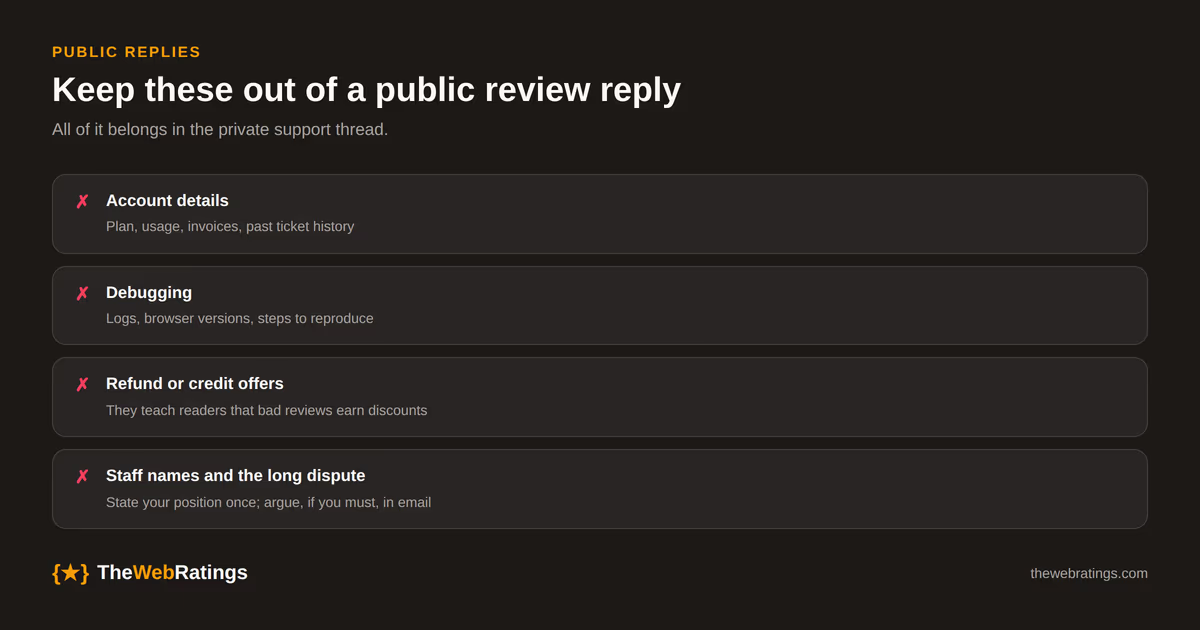
- Account details. Plan name, usage, invoice amounts, ticket history, and what the customer said in earlier support conversations. The reviewer chose to publish their review. They did not choose to publish their billing history, and posting it in a reply looks like retaliation even when it is meant as clarification.
- Debugging. Logs, browser versions, steps to reproduce. Prospects do not need it, and a long technical back-and-forth makes the problem look bigger than it was.
- Refunds and compensation. Offering a refund or credit in public trains readers that a bad review is the fastest path to a discount. Make the offer in private.
- Anything about your staff. Naming the support agent who made a mistake, or defending them by name, belongs nowhere public.
- The long version of a dispute. If you and the customer disagree about what happened, the public reply states your position once. The argument, if there has to be one, happens in email.
Which channel leads, by complaint type
The order changes with the kind of complaint. A rough guide we use:
| Complaint type | Lead with | Public reply should say | Private thread handles |
|---|---|---|---|
| Bug or outage | Public, then private | What broke, that it is fixed or being fixed | Data recovery, affected records, credits |
| Billing dispute | Private, then public | That you have reached out to sort it | Invoices, refunds, plan changes |
| Missing feature | Public only, usually | Whether it is planned, honestly | Optional: a beta invite if one exists |
| Misunderstanding of how the product works | Public, then private | The correct behavior, once, neutrally | Walkthrough or setup help |
| Complaint that started in support and leaked | Private first, then public | That the ticket is open and owned | The ticket itself |
| Fake or abusive review | Platform flag, plus a short public reply | A neutral note that you cannot find the account | Nothing; there is no customer to contact |
Billing disputes lead with private because the public reply has nothing useful to say until you know the facts, and a public "we've looked into your account and..." puts account details in the wrong place. Bugs lead with public because the reply itself is useful information for every other customer who hit the same bug.
The fake-review row has its own process. Every major platform removes reviews only for breaking a written content rule, and inaccuracy alone rarely qualifies, so the flag and the reply run in parallel. The details for Trustpilot, G2, Capterra, and Google are in review disputes: how flagging works on each platform.
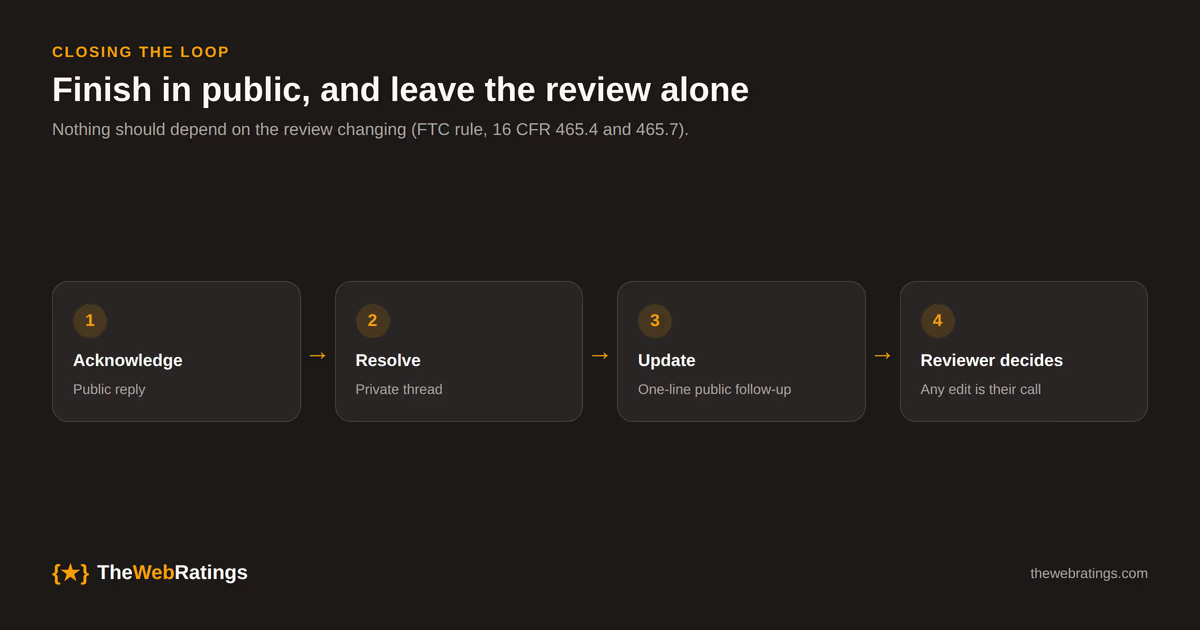
Close the loop in public, and leave the review alone
The step most teams skip is the second public reply. Once the private thread resolves the problem, go back and add a one-line update under your original reply: "Update: the export issue is fixed and Dana's data is restored." Prospects reading the profile months later see the whole arc, complaint to resolution, instead of a promise that may or may not have been kept.
Whether the reviewer changes their review is their decision. Most platforms let reviewers edit or update what they wrote, and some customers do once a problem is fixed. You can tell them the issue is resolved. What you should not do is make anything depend on the review changing.
That line has a legal edge in the US. The FTC's Consumer Review Rule (16 CFR Part 465) prohibits compensation conditioned on a review expressing a particular sentiment (section 465.4), and prohibits intimidation or unfounded legal threats used to get a review removed (section 465.7). A refund offered on the condition that the customer deletes or upgrades their one-star review sits close to both. Separately, the Consumer Review Fairness Act of 2016 voids clauses in standard-form contracts that restrict customers from posting honest reviews. Our walkthrough of the FTC fake review rule for SaaS covers what each section means in practice.
Catch complaints before they become reviews
The cheapest public complaint to handle is the one that went to support first. When a frustrated customer cannot find a way to reach a person quickly, a review site is often the most visible place to vent. A support link inside the product, a reply-to address on transactional emails that a human reads, and a status page during outages all give that frustration somewhere private to go.
Two cautions. Offering a private channel is fine, but showing the public review option only to happy customers is review gating, which Google's review policies prohibit for Google reviews and which the FTC rule treats as suppression if you present the result as your overall reviews. And a support channel that answers slowly just moves the complaint to a public site a few days later, with an extra grievance attached.
Disclosure: we build a review tool, so judge this section accordingly. TheWebRatings collects reviews through a widget inside your app, verifies every reviewer with an email one-time code, and lets you reply publicly to each review from the dashboard. Public replies are part of Pro at $19/mo; the plan details are on the pricing page.
Frequently asked questions
Usually both. Post a short public reply that acknowledges the problem, says what changed, and points to a private channel, then handle account details, debugging, and any refund in that private thread. A complaint resolved only in private still looks unanswered to prospects reading the review profile.
Leave out account details such as plan, usage, invoices and past ticket history, debugging steps and logs, refund or credit offers, and the names of individual staff members. The reviewer chose to publish their review, not their account history, and sharing it publicly tends to read as retaliation.
Conditioning a refund or credit on deleting or improving a review is risky. In the US, the FTC Consumer Review Rule prohibits compensation conditioned on a review expressing a particular sentiment and prohibits intimidation used to get reviews removed. Offer the refund on its merits and leave any change to the review up to the customer.
Billing disputes and complaints that already have an open support ticket are best handled privately first, because the public reply has nothing useful to say until you know the facts. Post a brief public note that you have reached out, then follow up publicly once it is resolved.
Yes. Adding a one-line public update under your original reply, saying the issue is fixed, lets future prospects see the full arc from complaint to resolution. It is one of the most persuasive things a review profile can show.