Free Ways to Get Your First 10 SaaS Reviews

The first ten reviews are a different problem from the next hundred. At that stage you have no review program, a short list of users who know your name, and no budget you want to spend on a review platform yet. You also have the most to gain: going from zero to roughly ten recent, specific reviews captures most of the trust benefit reviews will ever give you, a threshold we worked through in how many reviews your SaaS actually needs.
Every channel below costs nothing in cash. They differ a lot in where the review ends up, how quickly it arrives, and how easy it is to break the FTC's review rule by accident. This post fits inside our broader guide to customer reviews for SaaS. We build TheWebRatings, which appears as one of the options, so weigh that mention accordingly.
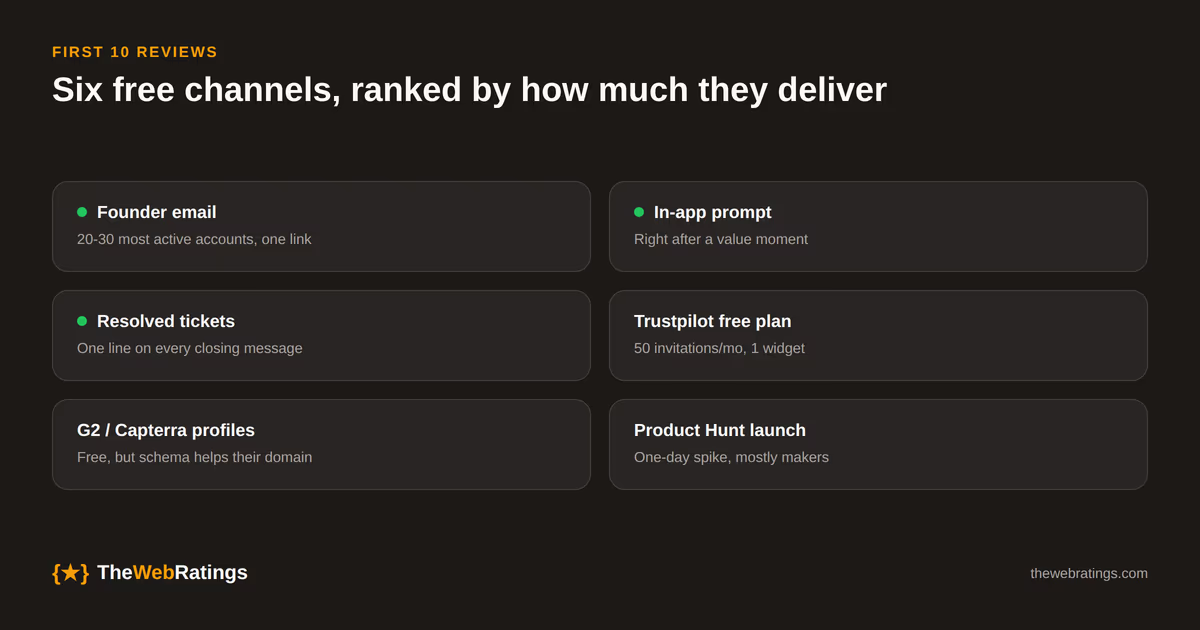
The channels side by side
Here is the short version. Competitor plan details come from the vendors' pricing pages, checked July 22, 2026.
| Channel | Cash cost | Where the review lands | Useful for the first 10? | Watch out for |
|---|---|---|---|---|
| Personal founder email | $0 | Wherever you link | Yes, the most dependable | Ask every active user, not only fans |
| In-app prompt at a value moment | $0 (TWR free plan, or build it) | Your review page | Yes, once usage is steady | Needs enough weekly actives to matter |
| Link after a resolved ticket | $0 | Wherever you link | A few | Send it to every closed ticket, not only happy ones |
| Trustpilot free plan | $0, 50 invitations/mo, 1 widget | trustpilot.com | Yes, with caveats | Anyone can review you; Starter is $99/mo billed annually |
| G2 or Capterra free profile | $0 | g2.com or capterra.com | Slowly | Schema benefits their domain; competitor ads can run on a free G2 profile |
| Product Hunt launch | $0 | producthunt.com | A one-day spike | Team and investor reviews need disclosure |
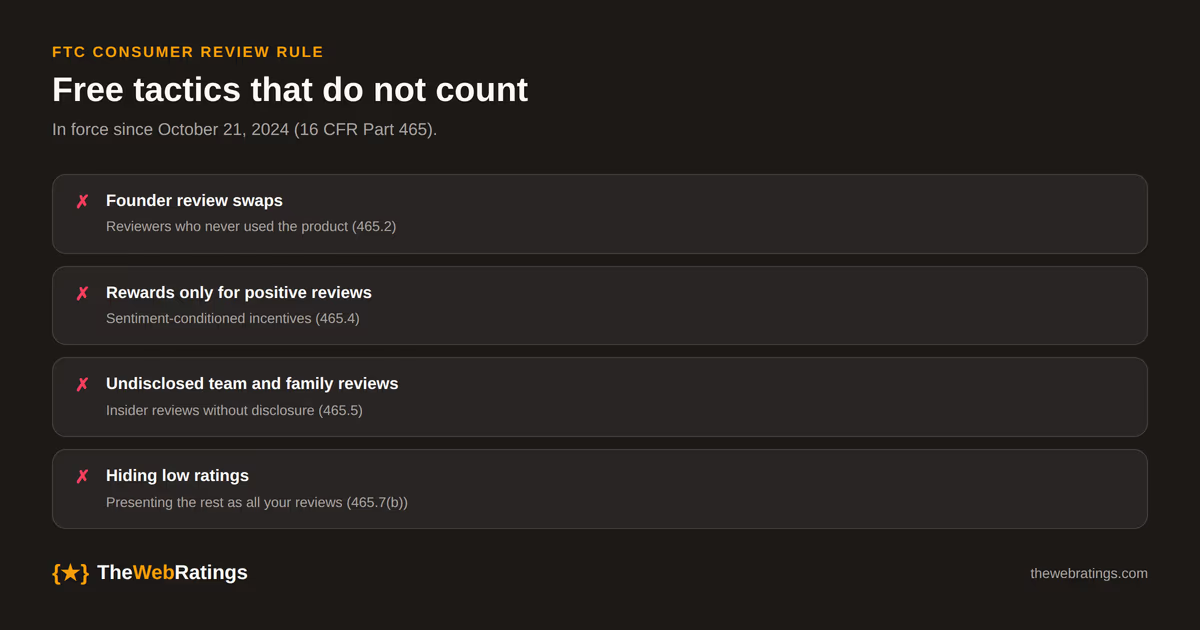
| Founder review swaps | $0 | Anywhere | No | A review from someone who never used the product is a fake review |
Personal email from the founder
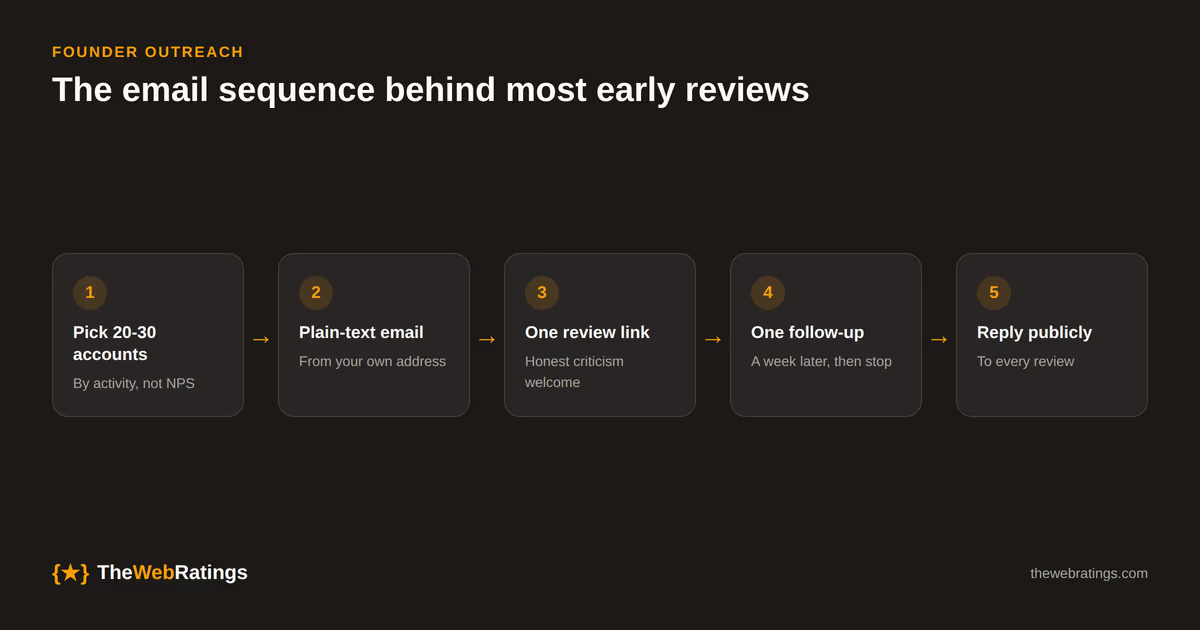
This is where most early SaaS reviews come from, and it works because it is a person asking a person. Pull your 20 to 30 most active accounts from the last month, write each one a short plain-text email from your own address, and include one link. Two or three sentences is enough: what you are asking for, why it helps a small team, and that honest criticism is welcome.
The rule that matters is who gets the email. Choose by activity, not by sentiment. If you filter the list down to people who gave you a 9 or 10 on an NPS survey, the reviews you collect will be stable and biased, and under section 465.7(b) of the FTC Consumer Review Rule you cannot then present that filtered set as your overall reviews. Asking every active user is both the honest option and the safe one.
Send one follow-up a week later, then stop. Two emails reads as a request. Four reads as a campaign. The copy that works in these messages is the same copy that works in product prompts, and we collected examples in how to ask for reviews without annoying your users.
In-app prompts at a value moment
Email reaches people when they are doing something else. A prompt inside the product reaches them right after the thing they came to do worked: the export finished, the first report rendered, the integration synced. That timing is why in-app collection tends to beat email once you have steady usage, and why it keeps working after the founder outreach list is exhausted.
The catch at the first-ten stage is volume. A prompt shown to a small fraction of weekly actives produces nothing if you only have 40 weekly actives. Ship the prompt early anyway, because it becomes the channel that keeps reviews recent after launch, and use founder email to fill the gap until usage catches up.
You can build this yourself with a modal and a form. The TheWebRatings free plan covers it without code beyond a script tag: one website, unlimited verified reviews, a collection widget, and a public review page, with the paid tiers on our pricing page if you later want replies or display widgets. Either way, show the prompt to everyone who reaches the moment, not to users you have already scored as happy.
Resolved support tickets
A user whose problem you just fixed is paying close attention to your product. Adding a single line to the closing message ("if you have a minute, an honest review helps us a lot") with a link is free and occasionally produces the most detailed review you will get all year.
Put the line on every closed ticket. If you add it only when the customer said thanks, you have rebuilt review gating with extra steps. Expect a handful from this channel, not ten.
Free profiles on third-party platforms
Trustpilot's free plan gives you a claimed profile, 50 review invitations a month, and one widget. That covers the first ten comfortably. Two caveats apply. Anyone can review any company on Trustpilot whether or not they used the product, so a small, new profile is exposed to drive-by reviews. And the first paid step is Starter at $99/mo on a 12-month contract, which is a big jump if the channel works and you outgrow 50 invitations.
G2 and Capterra both list you for free. Your reviews there help buyers who already shop on those directories, which matters for B2B products on enterprise shortlists. The review schema on those pages helps g2.com and capterra.com rank, not your domain, and on a free G2 profile competitor ads can appear on your own listing. Claim both profiles so they do not look abandoned, and send early reviewers there only if your buyers actually search there. The full comparison of what each free tier includes is in free review platforms compared.
Product Hunt
A launch can produce a burst of comments and reviews in a single day. The audience is mostly other makers, so reviews tend to praise the launch rather than describe long-term use, and they rarely help in Google for your own product name.
The legal trap is the launch-day message to your team, friends, and investors. Under section 465.5 of the FTC rule, reviews from officers, employees, and their immediate relatives need the relationship disclosed, and the company is responsible for making sure that happens when it asks. If you post an internal "go review us" message, include the disclosure instruction in the same message.
What does not count
Some free tactics show up in every founder forum and should stay out of your plan.
- Review swaps. Trading reviews with other founders produces reviews from people who never used your product. Section 465.2 covers reviews that misrepresent the reviewer's experience, and review platforms remove them when they spot the pattern.
- Rewards for positive reviews. A credit or gift offered only for five stars, or worded so the positive expectation is obvious, is banned by section 465.4. The same reward for every honest review, disclosed, is outside that section.
- Undisclosed team reviews. Covered above under section 465.5.
- Showing only the good ones. Hiding low ratings while implying the rest are all your reviews falls under section 465.7(b).
The FTC rule has applied since October 21, 2024, and civil penalties run up to $53,088 per violation.
Make the first 10 visible in search
Where the reviews land decides whether they ever show up next to your name in Google. Reviews you paste onto your own marketing site count as self-serving, and Google does not show review stars for them. Reviews on a third-party domain earn stars for that domain. An independent review page tied to your product, with valid AggregateRating markup, is the setup that can put stars on a search result about you.
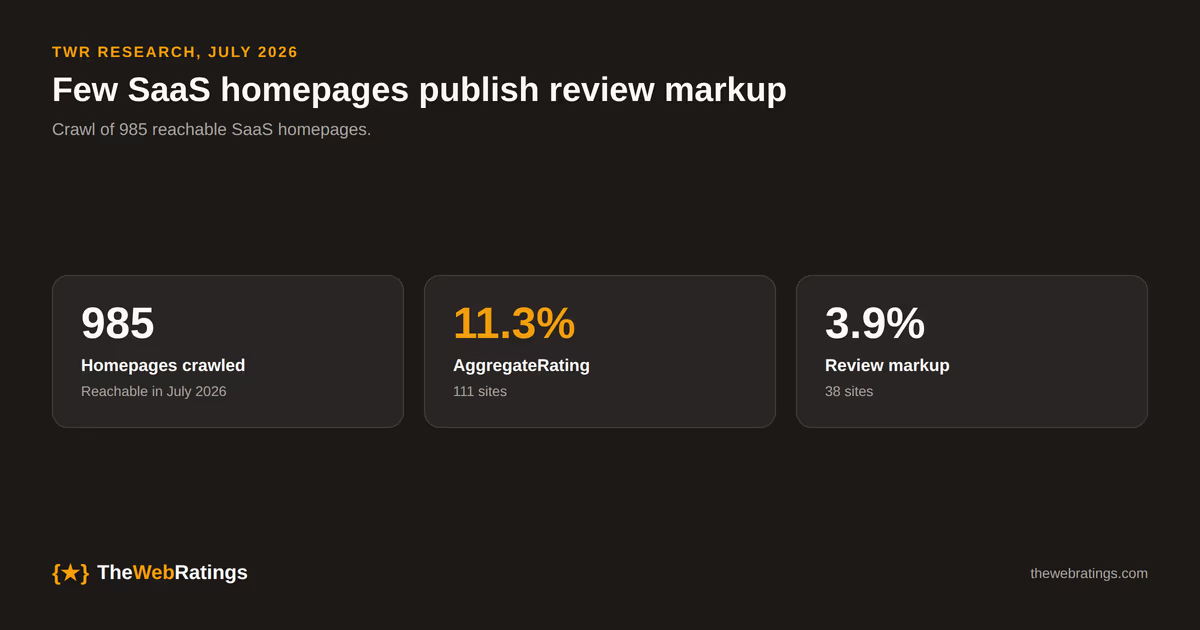
Very few SaaS products have this in place. In our July 2026 crawl of 985 reachable SaaS homepages, only 111 sites (11.3%) published AggregateRating markup and only 38 (3.9%) published Review markup. Ten honest reviews on a properly marked-up page already put you ahead of most of that sample.
Then reply to every review, including the critical ones. A specific, signed reply tells the next reader that a person reads these, and at ten reviews each reply is a large share of what a prospect sees.
Frequently asked questions
A short personal email from the founder to the 20 to 30 most active accounts, with one review link and a single follow-up a week later, is usually the fastest. Choose recipients by activity rather than by satisfaction score so the reviews stay representative and you avoid review gating.
You can ask, but under section 465.5 of the FTC Consumer Review Rule, reviews from officers, employees, and their immediate relatives must disclose the relationship, and the company has to make sure that happens when it solicits them. These reviews also carry little weight with buyers, so they should not make up your first ten.
Offering the same reward to every reviewer regardless of what they write, and disclosing it, falls outside section 465.4 of the FTC rule. A reward offered only for positive reviews, or worded so a positive review is clearly expected, is prohibited. Platform policies can be stricter than the law, so check the terms of the site where the review will appear.
Send them where your buyers already look. G2 and Capterra matter most for B2B products that appear on enterprise shortlists, and Trustpilot suits consumer-facing products. Reviews on those platforms help those domains rank, so if you want star ratings on search results about your own product, you also need an independent review page with valid review markup.
With an active user base and personal founder outreach, many small SaaS teams reach ten within a few weeks. Products with few weekly active users take longer, which is why it helps to ship an in-app review prompt early so collection continues after the outreach list runs out.
No. A review from someone who has not used your product misrepresents the reviewer's experience, which section 465.2 of the FTC rule covers, and review platforms remove swapped reviews when they detect the pattern. Ask your own users instead.